
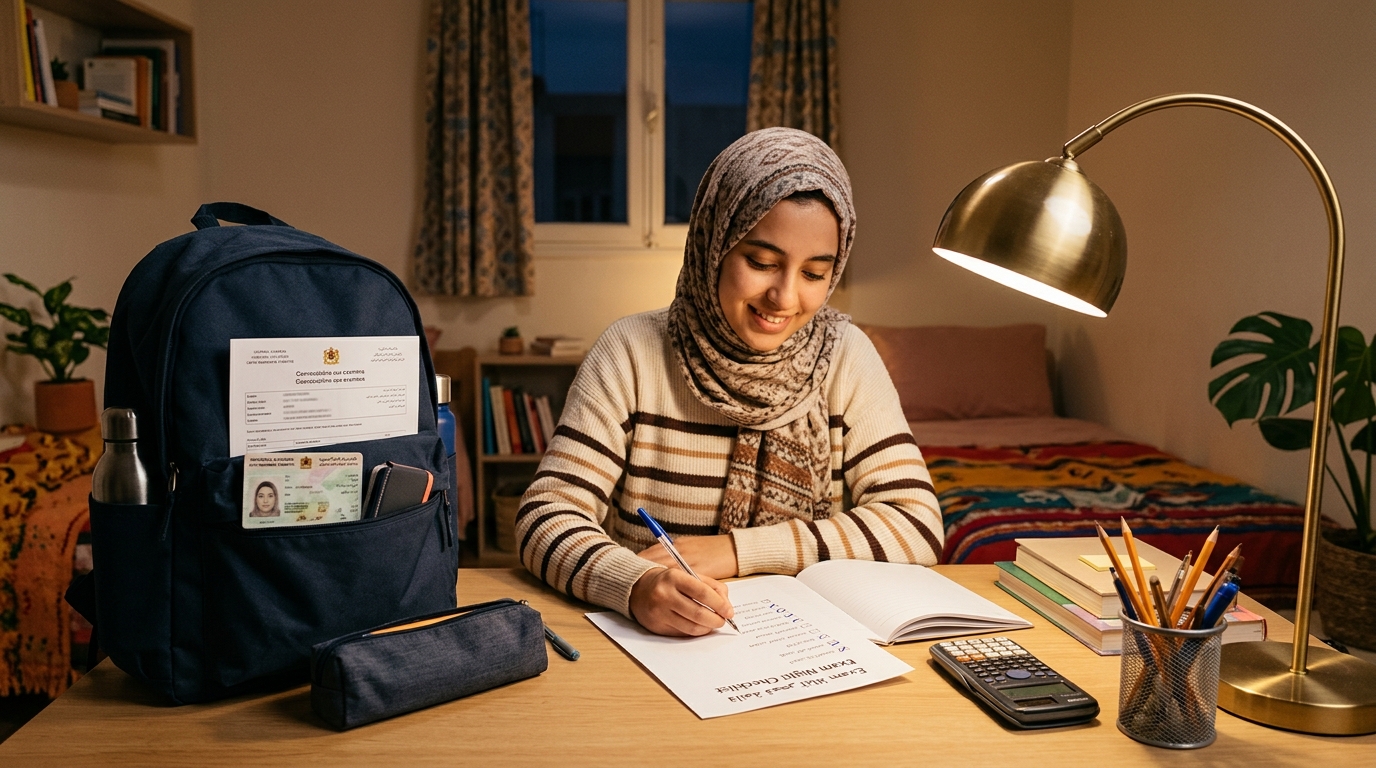
La reussite au concours ne se joue pas seulement sur tes connaissances : la veille et le jour J comptent enormement. Bien dormir, preparer ton sac, maitriser la grille de reponses et gerer ton stress sont des atouts concrets qui peuvent faire basculer ton classement. Voici ton guide complet, etape par etape.
Sommaire
La veille : sommeil, nutrition et preparation mentale
On va etre honnetes : la veille du concours, c'est deja trop tard pour apprendre de nouvelles notions. Ton cerveau a besoin de consolider ce qu'il sait, pas d'absorber des formules de derniere minute. Les etudes en neurosciences sont claires la-dessus : le sommeil est le moment ou ta memoire a long terme se solidifie. Alors ce soir, on ferme les cahiers.
Le sommeil : ton arme secrete
Vise 8 heures de sommeil minimum. Pas 6, pas 7. Huit. C'est la duree necessaire pour que ton hippocampe transfere correctement les informations de la memoire de travail vers la memoire a long terme. Couche-toi entre 22h et 23h maximum, et mets ton telephone en mode avion.
Le diner : leger et strategique
Oublie le couscous royal la veille du concours. Opte pour un repas leger : du poulet grille ou du poisson, des legumes, un peu de riz ou de pain complet. Les repas lourds et gras perturbent la digestion et la qualite du sommeil. Evite aussi le cafe apres 16h et les boissons sucrees.
La preparation mentale
Prepare tes affaires la veille au soir. Verifie ta convocation. Choisis tes vetements (confortables, en couches pour gerer la temperature de la salle). Fais une breve visualisation positive : imagine-toi assis(e) dans la salle, calme, concentre(e), en train de lire les questions sereinement. Puis dors. C'est tout.
Quoi mettre dans ton sac d'examen
La panique du matin, c'est quand tu cherches ta CIN pendant 20 minutes alors que tu devrais deja etre en route. Prepare tout la veille. Voici ta checklist complete :
| Objet | Obligatoire ? | Notes |
|---|---|---|
| Convocation imprimee | ✅ Oui | Imprime 2 exemplaires par securite |
| CIN originale | ✅ Oui | Verifie la date de validite |
| Stylos bleu/noir | ✅ Oui | Prends 2-3 stylos, les pannes arrivent |
| Crayon a papier (HB) | ✅ Oui | Pour remplir la grille de reponses |
| Gomme blanche | ✅ Oui | Gomme propre, sans trace de couleur |
| Calculatrice non-programmable | ✅ Oui | Verifie le modele autorise dans ta convocation |
| Bouteille d'eau | Recommande | Petite bouteille, etiquette retiree si exige |
| Montre analogique | Recommande | Les montres connectees sont interdites |
Arriver tot et gerer la grille de reponses
Arrive 30 a 45 minutes avant le debut de l'epreuve. Pas une heure (trop de stress a attendre), pas 10 minutes (risque de retard). Ce creneau te laisse le temps de trouver ta salle, t'installer, respirer, et lire les instructions affichees.
Comment fonctionne la grille de reponses
Au concours de medecine au Maroc, ta grille est lue par une machine optique (lecteur OMR). Elle detecte les marques de crayon dans les cases. Ce que ca signifie concretement : chaque bulle doit etre remplie completement, sans depasser, avec un crayon HB. Les marques legeres, les ratures et les coches au stylo peuvent etre mal lues ou non detectees.
Verifie toutes les 10 questions que le numero de la question sur ton sujet correspond bien au numero de la ligne sur ta grille. Un decalage d'une seule ligne peut fausser toutes tes reponses suivantes.
❓ Question de pratique - Biologie
Durant la mitose, a quelle phase les chromosomes se condensent-ils et deviennent visibles au microscope optique ?
- Metaphase
- Prophase
- Anaphase
- Telophase
Le rythme et la methode du passage rapide
Voici le scenario classique : tu tombes sur une question difficile a la question 8, tu passes 4 minutes dessus, et soudain tu realises que tu as 112 questions restantes pour 1h50. La panique s'installe. C'est exactement ce que la methode du passage rapide permet d'eviter.
Premier passage : recolter les points faciles
Lis chaque question. Si la reponse te vient en moins de 30-45 secondes, reponds et passe a la suivante. Si tu hesites, mets un petit point au crayon a cote du numero sur ton sujet et passe immediatement. Pas de reflexion, pas de "peut-etre que c'est B ou C". On avance. Pour un examen de 120 questions en 2 heures, tu disposes d'environ 1 minute par question. Mais en realite, beaucoup de questions se resolvent en 20-30 secondes si tu maitrises le sujet. Ce premier passage devrait prendre environ 60-70 minutes.
Second passage : maximiser les points restants
Avec le temps restant (idealement 40-50 minutes), reviens aux questions marquees. Tu auras souvent un regard plus frais dessus. Parfois, une question plus loin dans le sujet t'aura rappele une notion utile. Classe les questions marquees par ordre de difficulte : commence par celles ou tu hesitais entre 2 reponses (50% de chances), puis celles ou tu n'avais aucune idee.
✅ Avantages du passage rapide
- Tu securises d'abord les points que tu maitrises
- Tu reduis le stress en avancant vite
- Tu evites le blocage sur une seule question
- Tu gardes du temps pour les questions hesitantes
- Le second regard est souvent plus lucide
❌ Points d'attention
- Necessite de la discipline pour ne pas s'attarder
- Risque de decalage sur la grille si tu sautes des lignes
- Il faut s'entrainer avant le jour J pour etre a l'aise
- Peut creer du stress si trop de questions sont marquees
"J'ai utilise la methode du passage rapide au concours et ca a change ma vie. Au premier passage, j'ai repondu a 85 questions en 55 minutes. Au second passage, j'ai pu prendre le temps de bien reflechir aux 35 restantes. J'ai meme eu 15 minutes pour tout relire a la fin. Sans cette methode, je serais restee bloquee sur les questions de chimie organique et j'aurais manque de temps pour les questions faciles de physique."
Controle du stress le jour J
Le stress le jour du concours, c'est normal. Tout le monde le ressent, meme ceux qui ont l'air detendus. La difference, c'est que certains savent le gerer. Pas l'eliminer - le canaliser. Voici comment.
La respiration 4-7-8
Cette technique est redoutablement efficace. Inspire par le nez pendant 4 secondes. Retiens ta respiration pendant 7 secondes. Expire lentement par la bouche pendant 8 secondes. Repete 3 a 4 fois. Ca active ton systeme nerveux parasympathique et reduit la frequence cardiaque. Fais-le dans la file d'attente, a ton bureau avant la distribution des sujets, ou meme pendant l'examen si tu sens la panique monter.
La visualisation positive
Avant d'entrer dans la salle, ferme les yeux 30 secondes. Visualise-toi en train de lire les questions calmement, de cocher les reponses avec assurance, de garder le controle du temps. Ce n'est pas de la magie : les etudes montrent que la visualisation active les memes circuits neuronaux que l'action reelle. Les sportifs de haut niveau l'utilisent systematiquement.
Pour approfondir ces techniques, consulte notre article complet : Gerez votre stress et boostez votre concentration pour le concours 2026.
❓ Question de pratique - Chimie
On ajoute une petite quantite de HCl a une solution tampon phosphate (H2PO4- / HPO42-) a pH 7,2. Que se passe-t-il ?
- Le pH augmente fortement
- Le pH diminue legerement
- Le pH reste exactement le meme
- La solution n'est plus un tampon
"Le concours ne mesure pas seulement tes connaissances. Il mesure ta capacite a rester lucide sous pression. L'etudiant qui garde son calme gagne toujours des points sur celui qui panique, meme si leurs niveaux sont identiques."
- Pr. Nadia El Amrani, enseignante en biochimie, FMPR Rabat"La veille du concours, j'ai failli passer une nuit blanche a reviser. Ma soeur m'a convaincu d'arreter a 21h et de dormir. Le matin, j'ai fait la respiration 4-7-8 trois fois avant d'entrer dans la salle. Honnetement, je n'y croyais pas trop. Mais quand j'ai commence a lire les questions, j'etais d'un calme inhabituel. J'ai senti que je reflechissais mieux que lors de mes concours blancs."
L'etat d'esprit post-examen
L'epreuve est terminee. Tu sors de la salle. Et la, les discussions commencent : "T'as mis quoi a la 42 ?" "C'etait B ou C ?" Stop. C'est le piege numero un.
Ne compare pas tes reponses
Comparer tes reponses avec les autres ne sert strictement a rien, sauf a te stresser. Si tu decouvres que tu as fait une erreur, tu ne peux plus la corriger. Et souvent, la personne en face n'est pas sure non plus de sa reponse. Resiste a la tentation. Mets tes ecouteurs, appelle tes parents, mais ne reste pas dans le groupe qui debriefe question par question.
Repose-toi et decompresse
Que tu aies un seul examen ou plusieurs epreuves, accorde-toi du repos. Mange quelque chose que tu aimes. Fais une promenade. Si tu as une autre epreuve le lendemain, fais une revision legere le soir (1h maximum) et couche-toi tot. Pas de marathon de revision post-examen.
Prepare les etapes suivantes
Les resultats arriveront. En attendant, renseigne-toi sur les procedures d'inscription, les documents a fournir, les dates limites. Consulte notre checklist complete du jour J pour t'assurer que tu n'as rien oublie dans le processus global.
- Veille au soir : 8h de sommeil, diner leger, pas de revision de derniere minute
- Sac d'examen : convocation, CIN, stylos (x3), crayon HB, gomme, calculatrice, eau, montre
- Arrivee : 30-45 min avant, verifier la grille regulierement
- Passage rapide : 1er passage = questions faciles, 2nd passage = questions marquees
- Stress : respiration 4-7-8, visualisation positive, rester lucide
- Apres l'examen : ne pas comparer, se reposer, preparer la suite
Pret(e) a t'entrainer avant le jour J ?
Accede gratuitement a des milliers de QCM avec corrections detaillees. La meilleure preparation, c'est la pratique reguliere.
Commencer a reviser - 100% gratuit