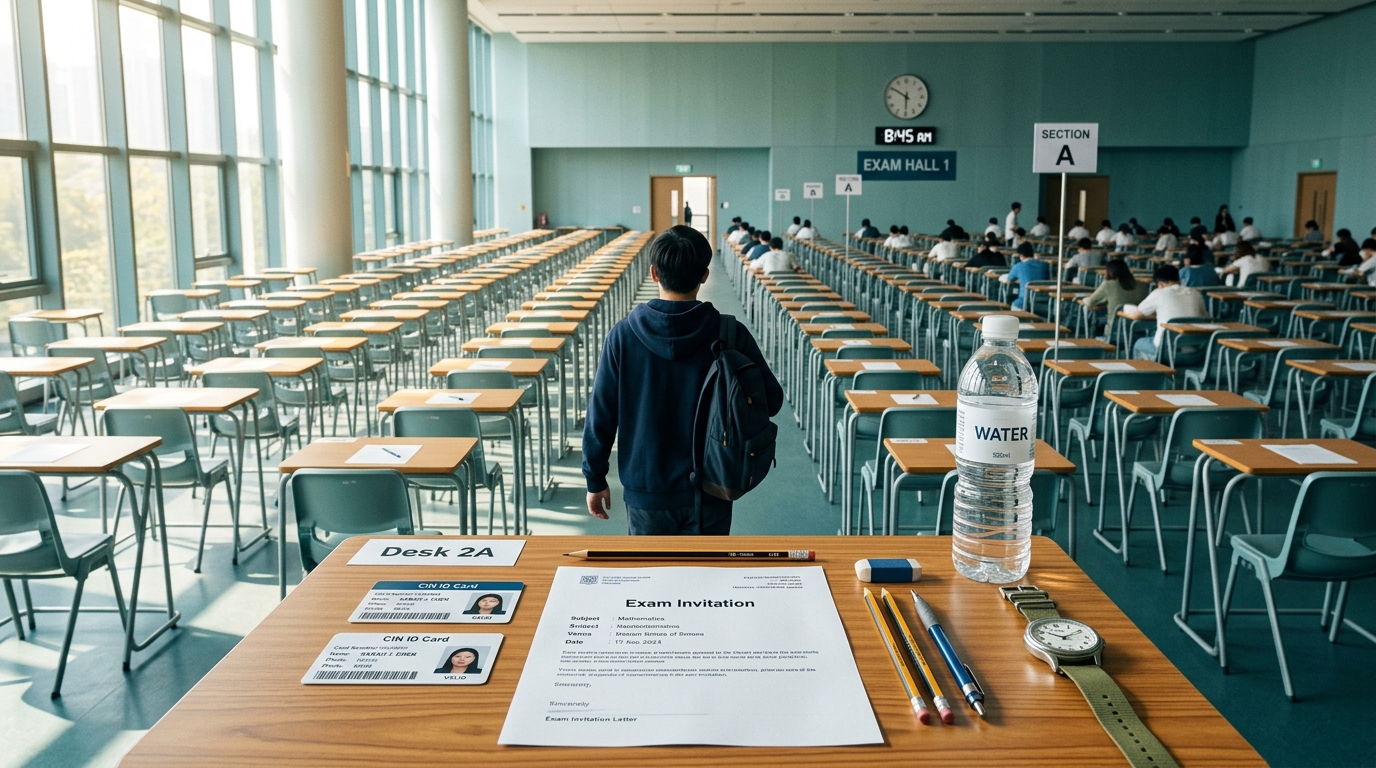

Le jour du concours se prépare autant que le programme. Cet article vous donne une checklist complète, des conseils pour gérer le stress et une stratégie de réponse optimale pour maximiser votre score.
Table of Contents
La veille du concours (J-1)
La veille du concours n'est PAS le moment de réviser intensivement. Si vous n'avez pas appris quelque chose en 4 mois de préparation, une nuit de bachotage ne changera rien. Ce qui peut changer, c'est votre état physique et mental le jour J.
Voici ce que font les étudiants admis la veille du concours :
- Relire leurs fiches de synthèse (30 min maximum)
- Vérifier la convocation et le matériel
- Repérer le trajet vers le centre d'examen
- Dîner léger et riche en glucides complexes
- Se coucher tôt (avant 22h)
- Éteindre le téléphone à 21h
Checklist du matériel à emporter
Préparez votre sac la veille pour éviter le stress du matin. Voici la liste complète :
| Catégorie | Élément | Obligatoire |
|---|---|---|
| Documents | CIN (Carte d'Identité Nationale) | OUI |
| Documents | Convocation imprimée | OUI |
| Documents | Photo d'identité (x2) | Selon le concours |
| Matériel | Stylos noirs (x3) | OUI |
| Matériel | Crayon HB + gomme (grille OMR) | OUI |
| Matériel | Montre analogique (sans connectivité) | Recommandé |
| Confort | Bouteille d'eau | Recommandé |
| Confort | Barre de céréales / fruits secs | Recommandé |
Le matin du concours
Réveillez-vous au moins 2 heures avant le début de l'épreuve. Votre cerveau a besoin de temps pour se mettre en marche. Voici un planning type pour un concours à 9h :
7h00 : Réveil + douche rapide. La douche aide à activer le système nerveux.
7h15 : Petit-déjeuner riche en protéines et glucides : oeufs, pain complet, orange. Évitez le café en excès (max 1 tasse) car il peut amplifier l'anxiété.
7h45 : Départ vers le centre d'examen. Arrivez au moins 30 minutes en avance.
8h30 : Installation en salle. Respirations profondes. Relecture rapide de vos formules clés si nécessaire.
Stratégie de réponse optimale
Le concours de médecine comporte 120 QCU en 2 heures, soit exactement 1 minute par question. Voici la stratégie utilisée par les meilleurs candidats :
Premier passage (45 min) : les questions faciles
Parcourez tout le sujet et répondez immédiatement aux questions dont vous êtes sûr. Ne passez pas plus de 30 secondes par question lors de ce premier passage. Objectif : répondre à 60-70 questions.
Deuxième passage (45 min) : les questions moyennes
Revenez aux questions que vous avez sautées et prenez le temps de les analyser. Éliminez les options clairement fausses et choisissez parmi les restantes. Objectif : répondre à 30-40 questions supplémentaires.
Dernier passage (30 min) : vérification
Vérifiez vos réponses sur la grille OMR. Ne changez une réponse que si vous avez une raison solide. Votre première intuition est correcte dans 65% des cas.
❓ Question de pratique - Stratégie
Si vous hésitez entre 2 réponses sur un QCU et que vous n'avez plus de temps :
- Laisser la question sans réponse
- Choisir la première option
- Choisir l'option la plus longue et détaillée
- Choisir votre première intuition
Gérer le stress pendant l'épreuve
"Quand j'ai ouvert le sujet et que j'ai vu des questions inconnues, j'ai paniqué. Puis je me suis rappelé le conseil de FMPrepa : premier passage rapide sur les questions faciles. J'ai retrouvé ma confiance et j'ai terminé avec 15 minutes d'avance."
Le stress est normal et même utile (il vous rend plus alerte). Mais s'il devient paralysant, voici 3 techniques rapides :
- La respiration 4-7-8 : Inspirez 4 secondes, retenez 7 secondes, expirez 8 secondes. Répétez 3 fois. Cela active le système nerveux parasympathique et réduit l'anxiété en 60 secondes.
- La technique du "stop" : Si vous bloquez sur une question, dites-vous mentalement "STOP", passez à la suivante, et revenez plus tard. Ne laissez pas une question difficile miner votre confiance.
- Le recadrage : Rappelez-vous que vous êtes préparé. Vous avez fait des centaines de QCM sur FMPrepa. Cette situation, vous l'avez déjà vécue en simulation.
"Le stress ne vient pas de la difficulté de l'examen, mais de l'impression de ne pas être préparé. Préparez-vous bien, et le stress devient votre allié."
- Dr. Amina R., psychologue scolaire, Rabat"J'ai passé 150 simulations en mode examen sur FMPrepa avant le jour J. Le vrai concours m'a semblé... normal. Pas de surprise, pas de panique. C'était juste une simulation de plus."
Après le concours
Le concours est terminé. Voici ce que vous devez faire :
- Ne vérifiez pas vos réponses immédiatement. Cela ne sert à rien et crée du stress inutile.
- Reposez-vous. Votre cerveau a travaillé à plein régime pendant 2 heures.
- Célébrez votre effort. Quel que soit le résultat, vous avez fait de votre mieux.
- Si vous avez d'autres concours (ENSA, ENSAM, ENCG), gardez votre élan et reprenez la préparation le lendemain.
✅ À faire le jour J
- Arriver 30 min en avance
- Faire 3 passages (facile → moyen → vérification)
- Respirer si le stress monte
- Ne jamais laisser une question sans réponse
❌ À ne pas faire
- Réviser de nouvelles notions la veille
- Boire 3 cafés le matin
- Passer 5 min sur une seule question
- Vérifier ses réponses avec les autres à la sortie
- Préparez votre matériel la veille (CIN, convocation, 3 stylos, crayon)
- Réveillez-vous 2h avant l'épreuve
- Utilisez la stratégie des 3 passages
- Ne changez pas vos réponses sans raison solide
- Le stress est normal : respirez et avancez
Préparez-vous avec des simulations réalistes
Le mode examen de FMPrepa simule les conditions réelles du concours. Entraînez-vous gratuitement.
Lancer une simulation