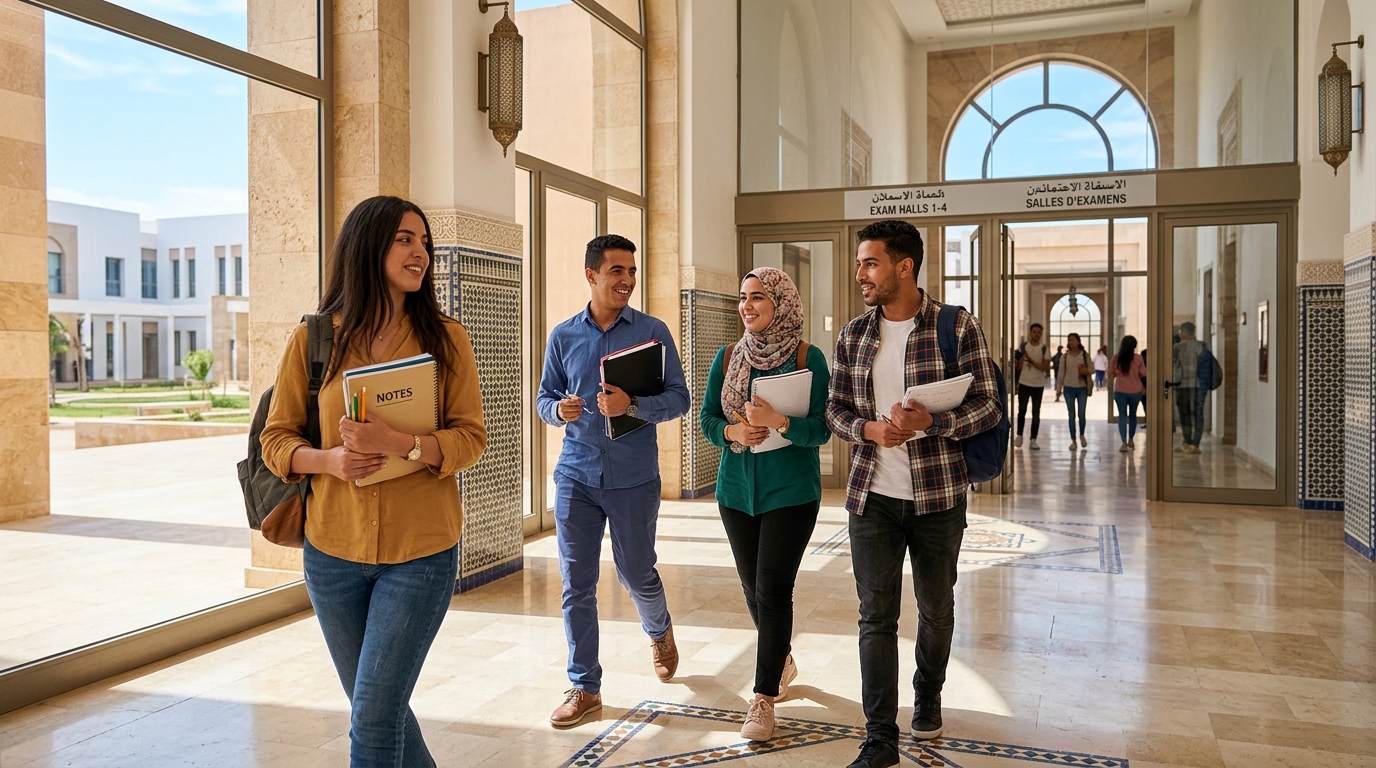
Ce guide couvre les 5 concours post-bac majeurs au Maroc en 2026 : Medecine, ENSA, ENSAM, ENCG et ISPITS. Tout y est - la checklist avant l'examen, le format exact de chaque epreuve, les tactiques QCM pour gerer ton temps, et les demarches apres les resultats. Un seul article, zero surprise le jour J.
Sommaire
Comment fonctionne ce walkthrough
Tu passes le bac cette annee et tu vises medecine, l'ENSA, l'ENSAM, l'ENCG ou les ISPITS ? Peut-etre meme plusieurs a la fois. Le probleme : chaque concours a ses propres regles, ses propres matieres, son propre rythme. Et les informations fiables sont dispersees entre des groupes Facebook, des PDF officiels qu'on ne retrouve plus, et les rumeurs du lycee.
Ce guide rassemble tout. Chaque section suit la chronologie reelle : ce que tu fais avant l'examen, ce qui t'attend pendant l'epreuve, et ce qui se passe apres les resultats. On ne parle pas d'un seul concours - on les couvre tous les cinq, avec les differences cles et les pieges propres a chacun.
L'objectif est simple : que tu puisses lire cet article aujourd'hui et te presenter demain sans aucune zone d'ombre. Pas de surprise sur le nombre de questions, pas de panique sur les documents a apporter, pas de confusion sur les demarches d'inscription. Que tu cibles l'ENSA, l'ENSAM ou l'ENCG, ou que tu vises la blouse blanche en medecine, le plan de bataille est ici.
Avant l'examen : la checklist universelle
Peu importe le concours que tu passes, certains elements sont non negociables. Oublie un seul document et tu risques de ne pas entrer dans la salle. Ca parait basique, mais chaque annee des dizaines d'etudiants se font refouler a la porte. Voici ta checklist complete :
Documents obligatoires
- Carte d'Identite Nationale (CIN) - originale, en cours de validite. Pas de photocopie, pas de permis de conduire.
- Convocation officielle - telechargeable depuis cursussup.gov.ma. Imprime-la en deux exemplaires (on ne sait jamais).
- Releve de notes du bac - pour certains concours, on te le demandera a l'entree ou apres l'epreuve.
Materiel autorise
- Stylos noirs - au moins 3 (les grilles optiques n'acceptent que le noir). Prends des BIC classiques, pas de stylo a friction.
- Calculatrice scientifique non programmable - obligatoire pour ENSA et ENSAM, interdite en medecine. Verifie le reglement specifique de ton concours.
- Montre analogique - les montres connectees sont interdites partout. Une montre classique te permettra de gerer ton temps sans dependre de l'horloge murale.
- Bouteille d'eau - transparente, sans etiquette. 3 heures d'epreuve sans eau, c'est long.
La veille de l'examen
Repere ton centre d'examen la veille si possible. Note le temps de trajet reel (pas celui de Google Maps un dimanche a 6h). Prevois d'arriver 45 minutes avant l'heure indiquee sur la convocation. Les portes ferment souvent 15 minutes avant le debut, et apres ca, c'est termine.
Prepare tout dans un sac la veille au soir : CIN, convocation, stylos, calculatrice, montre, bouteille d'eau. Le matin du jour J, tu n'as qu'a attraper ton sac et partir. Pour plus de details sur cette preparation mentale et logistique, consulte notre guide du Jour J pour le concours de medecine.
Format de chaque epreuve
C'est ici que les choses deviennent concretes. Chaque concours a un format tres different - nombre de questions, matieres, duree, systeme de notation. Connaitre ces details te donne un avantage enorme sur les candidats qui decouvrent le format en ouvrant le sujet.
| Concours | Matieres | Format | Duree | Nb Questions | Points cles |
|---|---|---|---|---|---|
| Medecine | Biologie, Chimie, Physique, Maths | QCM (une seule reponse) | 3h | 120 | Pas de points negatifs, grille optique |
| ENSA | Maths, Physique | QCM | ~2h30 | 80-100 | Niveau TS, exercices calculatoires |
| ENSAM | Maths, Physique, Dessin technique | QCM + exercices techniques | ~3h | 80-100 | Pieges d'unites (cm vs m), schemas |
| ENCG (TAFEM) | Logique, Verbal, Quantitatif, Culture gen. | QCM psychotechnique | ~2h | 100-120 | Rapidite > precision, pas de maths avancees |
| ISPITS | Biologie, Chimie, Physique, Francais | QCM | ~1h30 | 40 | Questions courtes, programme bac SVT |
Medecine : la structure detaillee
120 questions en 3 heures. Reparties a peu pres ainsi : 40 en biologie, 30 en chimie, 30 en physique, 20 en maths. Pas de points negatifs - donc ne laisse jamais une question sans reponse. Meme en cochant au hasard, tu as 20 a 25% de chances de tomber juste. Sur 120 questions, ca peut representer 5 a 6 points gratuits.
ENSA et ENSAM : les differences subtiles
Les deux concours testent les maths et la physique, mais l'ENSAM ajoute une composante technique (dessin industriel, schemas). Les questions ENSA sont souvent plus calculatoires, tandis que l'ENSAM teste ta capacite a lire un schema technique et a convertir des unites. Si tu passes les deux, entraine-toi specifiquement sur les conversions d'unites pour l'ENSAM.
ENCG (TAFEM) : un format a part
Le Test d'Aptitude a la Formation en Management (TAFEM) ne ressemble a aucun autre concours. Pas de biologie, pas de chimie. C'est un test psychotechnique : logique, comprehension verbale, raisonnement quantitatif et culture generale. La cle ici, c'est la vitesse. Les questions ne sont pas difficiles individuellement, mais le volume est enorme.
❓ Question de pratique - Biologie
Le reticulum endoplasmique rugueux (RER) est principalement implique dans :
- La synthese des lipides membranaires
- La synthese et la maturation des proteines destinees a la secretion
- La production d'ATP par phosphorylation oxydative
- Le stockage du calcium intracellulaire
Rythme et tactiques QCM
Connaitre le format ne suffit pas. Il faut aussi savoir comment gerer ton temps et eviter les pieges classiques. Voici les tactiques qui font la difference entre les candidats qui terminent sereinement et ceux qui paniquent a la derniere demi-heure.
Le rythme a respecter
| Concours | Temps par question | Strategie recommandee |
|---|---|---|
| Medecine (120Q / 3h) | ~1 min 30 | Premier passage rapide, marque les doutes, 2e tour |
| ENSA (90Q / 2h30) | ~1 min 40 | Fais les maths d'abord si c'est ton point fort |
| ENSAM (90Q / 3h) | ~2 min | Attention aux unites, verifie chaque conversion |
| ENCG (110Q / 2h) | ~1 min 05 | Vitesse maximale, pas de perfection |
| ISPITS (40Q / 1h30) | ~2 min 15 | Plus de temps, sois precis et relis |
La technique des deux passages
C'est la methode la plus efficace pour le concours de medecine. Premier passage : tu lis chaque question et tu reponds immediatement si tu connais la reponse (moins de 30 secondes). Si tu hesites, tu marques la question et tu passes a la suivante. Deuxieme passage : tu reviens sur les questions marquees avec le temps restant. Cette technique evite de bloquer 5 minutes sur une question difficile alors que 3 questions faciles t'attendent plus loin.
"Le concours ne recompense pas ceux qui savent tout. Il recompense ceux qui savent gerer leur temps et repondre a ce qu'ils connaissent."
- Dr. Nadia K., professeur de biologie, FMPC CasablancaLes pieges classiques de l'ENSAM
L'ENSAM adore les pieges d'unites. Un enonce donne une longueur en centimetres, une autre en metres, et la reponse attendue est en millimetres. Si tu ne fais pas attention a la conversion, tu obtiens un resultat qui correspond a l'une des mauvaises propositions - et c'est fait expres. Avant chaque calcul, ecris les unites a cote de chaque valeur. C'est 10 secondes de plus qui t'evitent de perdre un point.
❓ Question de pratique - Physique
Un condensateur de capacite C = 10 μF est charge sous une tension U = 200 V. L'energie emmagasinee dans ce condensateur vaut :
- 0,1 J
- 0,2 J
- 1 J
- 2 J
"La technique des deux passages m'a sauve. Au premier tour j'ai repondu a 85 questions en 1h30. Au deuxieme tour, j'ai eu tout le temps de reflechir aux 35 restantes. Sans ca, j'aurais panique apres la question 60."
Apres l'examen : les bons reflexes
L'epreuve est terminee. Tu sors de la salle. Premiere tentation : comparer tes reponses avec les autres candidats dans le couloir. Ne fais pas ca. Serieusement. Voici pourquoi et ce que tu devrais faire a la place.
Pourquoi eviter la comparaison de reponses
D'abord, la memoire post-examen est trompeuse. Tu ne te souviens pas parfaitement de ce que tu as coche - et les autres non plus. Ensuite, si tu decouvres que ta reponse est differente de celle de trois personnes, tu vas stresser pour rien pendant des jours. Et ca ne changera absolument rien a ta copie. L'epreuve est terminee. Ce qui est fait est fait.
"Apres l'epreuve de l'ENSA, tout le monde comparait les reponses de physique. J'ai prefere partir directement et me concentrer sur la preparation de mon dossier ENSAM qui etait 3 jours plus tard. Meilleure decision."
"J'ai passe 4 concours differents en 2 semaines. Le secret ? Apres chaque epreuve, je fermais le chapitre et j'ouvrais le suivant. Pas de regrets, pas de calculs de points. FMPrepa m'a aide a structurer mes revisions entre les epreuves."
Prepare tes dossiers d'inscription maintenant
Plutot que de ruminer sur l'examen, utilise ce temps pour preparer les documents d'inscription. En cas d'admission, tu auras souvent moins d'une semaine pour constituer ton dossier. Voici ce que la plupart des ecoles demandent :
- Photocopies certifiees de la CIN
- Releve de notes du baccalaureat (original + copies)
- Attestation de reussite au baccalaureat
- Photos d'identite recentes (6 a 8 selon l'ecole)
- Certificat medical d'aptitude
- Enveloppes timbrees (oui, certaines ecoles en demandent encore)
✅ A faire apres l'examen
- Preparer le dossier d'inscription a l'avance
- Se reposer et decompresser
- Reviser pour le concours suivant si tu en passes plusieurs
- Consulter les annales sur FMPrepa pour progresser
❌ A eviter absolument
- Comparer ses reponses dans le couloir
- Calculer son score approximatif
- Lire les "corrections" non officielles sur Facebook
- Se decourager avant meme les resultats
Resultats et inscription definitive
Les resultats tombent generalement entre 1 et 3 semaines apres l'epreuve, selon le concours. Voici ce que tu dois savoir sur le processus, qu'il s'agisse de medecine, de l'ENSA ou de tout autre concours.
Admis vs liste d'attente
Si tu es sur la liste principale (admis directement) : felicitations. Tu as un delai strict (souvent 48 a 72 heures) pour confirmer ton inscription et deposer ton dossier. Ne tarde pas - un retard, meme d'un jour, peut te couter ta place.
Si tu es sur la liste d'attente : pas de panique. Chaque annee, un nombre significatif de places se libere parce que des admis choisissent une autre ecole. Pour medecine, il n'est pas rare que la liste avance de 50 a 100 places. Garde ton telephone charge et ton dossier pret.
- Les resultats sont publies sur les sites officiels des ecoles et sur cursussup.gov.ma
- Le delai d'inscription est tres court : 48 a 72 heures pour la liste principale
- La liste d'attente avance reellement - garde espoir et ton dossier pret
- Tu peux etre admis a plusieurs ecoles - c'est le moment de choisir
- L'inscription definitive se fait en personne dans l'etablissement
Choisir entre plusieurs admissions
Si tu es admis dans plusieurs etablissements, c'est un luxe que beaucoup t'envient. Mais c'est aussi un choix important. Pour t'aider a comparer les ecoles d'ingenieurs, consulte notre comparaison detaillee ENSA vs ENSAM vs ENCG. Et pour eviter les erreurs qui coutent cher dans le processus d'inscription, lis les erreurs fatales a eviter lors des concours au Maroc.
Prends le temps de reflechir : ville, specialites proposees, debouches, cout de la vie sur place. Parle a des etudiants actuels si possible - leurs retours valent mieux que n'importe quel classement.
Pret a t'entrainer pour le jour J ?
Accede gratuitement a des milliers de QCM avec corrections detaillees pour chaque concours post-bac. Medecine, ENSA, ENSAM, ENCG, ISPITS : tout est sur FMPrepa.
Commencer les QCM