
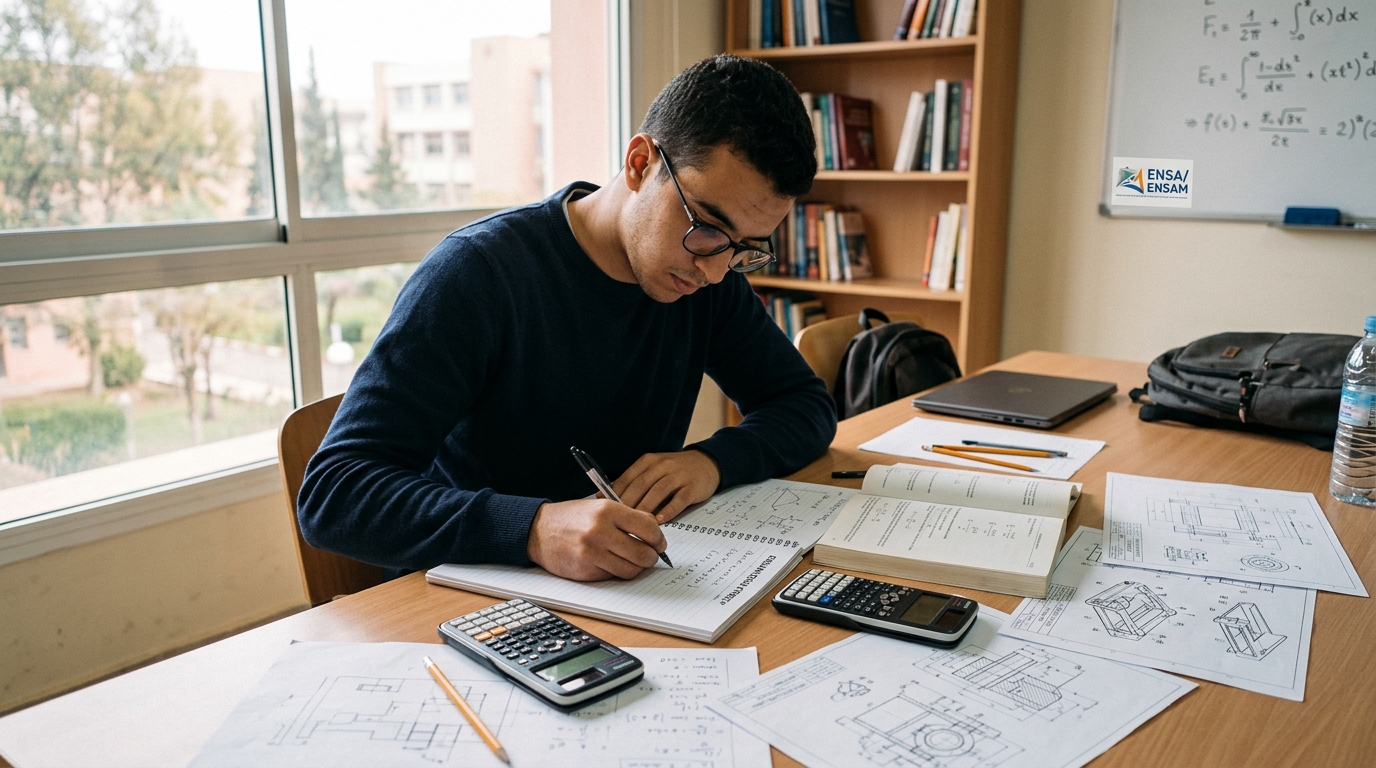
Le concours ENSA et ENSAM 2026 repose sur un QCM de math et physique. Ce guide couvre les differences entre les deux concours, les themes les plus frequents (cinematique, optique, circuits RLC, analyse, algebre lineaire), et une strategie de revision basee sur 412 QCM corriges issus des annales 2018-2024. Bonus : 3 QCM d'entrainement pour tester vos reflexes.
Sommaire
ENSA vs ENSAM : quelles differences ?
On confond souvent les deux. C'est normal : ENSA et ENSAM partagent le meme format (QCM), la meme periode de concours, et attirent le meme profil d'etudiants. Pourtant, les differences sont reelles, et elles changent la donne en termes de preparation.
Les ENSA (Ecoles Nationales des Sciences Appliquees) forment des ingenieurs generalistes repartis sur 11 ecoles au Maroc. Le concours est relativement accessible : pas de notation negative, un QCM qui teste les bases solides du tronc commun scientifique. L'objectif est de verifier que tu maitrises les fondamentaux.
Les ENSAM (Ecoles Nationales Superieures des Arts et Metiers), elles, visent un cran au-dessus. Moins de places, des questions plus techniques, et surtout la fameuse notation negative qui penalise les reponses au hasard. Ici, il ne suffit pas de connaitre le cours : il faut etre rapide, precis, et strategique.
| Critere | ENSA | ENSAM |
|---|---|---|
| Nombre d'ecoles | 11 ecoles | 2 ecoles (Casablanca, Meknes) |
| Places (environ) | 3 000 - 3 500 | 600 - 800 |
| Matieres QCM | Math + Physique | Math + Physique |
| Duree totale | 3h (1h30 + 1h30) | 3h (1h30 + 1h30) |
| Coefficient | 50% QCM + 50% Bac | QCM predominant |
| Notation negative | Non | Oui (-0.25 par erreur) |
| Difficulte | Moyenne | Elevee |
| Villes principales | Kenitra, Marrakech, Fes, Tanger, Agadir... | Casablanca, Meknes |
Bonne nouvelle : tu peux passer les deux concours la meme annee. Les dates sont generalement decalees de quelques jours. Beaucoup d'etudiants tentent ENSA comme "filet de securite" et visent l'ENSAM en parallele. Prepare-toi pour le niveau ENSAM, et tu seras a l'aise partout.
Dates, preselection et seuils 2026
Avant meme de penser aux revisions, il faut d'abord etre preselectionne. Pour les ENSA, le seuil tourne generalement autour de 12/20 au Bac (toutes matieres confondues). Pour l'ENSAM, c'est un peu plus exigeant : les notes en math et physique comptent davantage, et les seuils varient d'une annee a l'autre.
Calendrier previsionnel 2026
- Mai - juin 2026 : Ouverture des inscriptions en ligne sur les plateformes officielles
- Fin juin 2026 : Publication des listes de preselection
- Premiere quinzaine de juillet 2026 : Epreuves QCM (dates exactes a confirmer)
- Fin juillet 2026 : Resultats d'admission
Attention : Les seuils de preselection changent chaque annee en fonction du nombre de candidats et de la difficulte du Bac. En 2024, certaines ENSA ont accepte des profils a partir de 11.5/20, tandis que d'autres exigeaient 13/20. Ne te fie pas a un chiffre unique : verifie les seuils specifiques de chaque ecole.
Le piege classique ? Attendre les resultats du Bac pour commencer a reviser. Les meilleurs candidats commencent des le mois de mars, bien avant la fin des cours. Deux a trois mois de preparation ciblee font toute la difference.
Source officielle : Consulte toujours le site du ministere de l'Enseignement Superieur et les pages officielles des ecoles pour les dates exactes. Les informations circulent parfois en retard sur les reseaux sociaux, et tu ne veux pas rater une deadline.
Format de l'epreuve : decryptage Math et Physique
Entrons dans le vif du sujet. Voici comment se decomposent les epreuves :
Epreuve de Mathematiques
Environ 30 questions en 1h30. Ca te laisse 3 minutes par question, ce qui semble correct sur le papier. En realite, certaines questions se resolvent en 30 secondes, d'autres demandent 5 minutes de calcul. La gestion du temps est la competence numero un.
Les grands axes :
- Analyse : limites, derivees, integrales, etude de fonctions, suites numeriques
- Algebre lineaire : matrices, determinants, systemes lineaires, espaces vectoriels
- Geometrie : vecteurs, droites, plans, produit scalaire, nombres complexes
- Probabilites et statistiques : denombrement, lois de probabilite, esperance
Epreuve de Physique
Meme format : 30 questions environ, 1h30. La physique est souvent la ou les candidats perdent le plus de points, surtout a cause des pieges d'unites et des formules mal memorisees.
Les themes principaux :
- Mecanique : cinematique, dynamique, travail et energie
- Optique : lentilles, miroirs, diffraction
- Electricite : circuits RLC, lois de Kirchhoff, condensateurs
- Thermodynamique : premier principe, gaz parfaits, cycles
- Ondes : ondes mecaniques, ondes lumineuses
Notation negative : le facteur ENSAM
A l'ENSAM, chaque mauvaise reponse te coute -0.25 point. Ca change completement la strategie. Si tu n'es pas sur a au moins 60% d'une reponse, il vaut mieux laisser la question vide. Aux ENSA, pas de penalite : tu peux tenter ta chance sans risque.
QCU vs QCM, c'est quoi la difference ? Un QCU (Question a Choix Unique) n'a qu'une seule bonne reponse parmi les propositions. Un QCM (Question a Choix Multiples) peut avoir plusieurs bonnes reponses a cocher. Aux concours ENSA et ENSAM, la majorite des questions sont des QCU, mais quelques QCM apparaissent parfois en physique. Lis bien la consigne de chaque question.
QCM d'entrainement #1 - Physique (Condensateur)
Un condensateur de capacite C = 10 µF est charge sous une tension U = 200 V. Quelle est l'energie stockee ?
- 0.02 J
- 0.2 J
- 2 J
- 20 J
Themes les plus frequents aux concours
On a analyse les annales de 2018 a 2024 pour identifier les sujets qui reviennent le plus souvent. Certains themes tombent chaque annee sans exception. D'autres sont plus rares mais valent des points faciles si tu les connais.
| Theme | Matiere | Frequence (2018-2024) | Niveau de difficulte |
|---|---|---|---|
| Cinematique et dynamique | Physique | 92% | Moyen |
| Circuits RLC / Electricite | Physique | 88% | Moyen - Eleve |
| Analyse (derivees, integrales) | Math | 100% | Moyen |
| Algebre lineaire (matrices, determinants) | Math | 85% | Eleve |
| Optique geometrique | Physique | 78% | Moyen |
| Suites numeriques | Math | 72% | Moyen |
| Thermodynamique | Physique | 65% | Eleve |
| Nombres complexes | Math | 60% | Moyen |
| Probabilites | Math | 55% | Facile - Moyen |
| Ondes mecaniques | Physique | 50% | Moyen |
Ce tableau te dit ou concentrer tes efforts. L'analyse et la cinematique representent a eux seuls pres de 35% des questions. Si tu les maitrises, tu securises deja un tiers du QCM.
"J'ai passe trois semaines a fond sur l'algebre lineaire alors que la cinematique tombait a chaque session. Quand j'ai change de strategie et priorise les themes frequents, j'ai gagne 8 points en QCM blanc."
Youssef K., admis ENSAM Casablanca 2024Strategie maligne : Commence par les themes a plus de 75% de frequence. Ce sont tes points "garantis" si tu bosses correctement. Les themes a 50-60% meritent ton attention ensuite, mais ne sacrifie jamais les fondamentaux pour des sujets rares.
QCM d'entrainement #2 - Physique (Cinematique)
Un objet part du repos avec une acceleration constante a = 2 m/s². Quelle distance parcourt-il en t = 5 s ?
- 10 m
- 25 m
- 50 m
- 12.5 m
Le piege des unites : 15% des erreurs ENSAM
Parlons du tueur silencieux du concours. D'apres notre analyse des erreurs les plus courantes sur les annales corrigees, environ 15% des mauvaises reponses a l'ENSAM sont liees a un probleme de conversion d'unites. Pas un manque de connaissance, juste une erreur de virgule ou de prefixe.
Les pieges les plus courants :
- cm vs m : une distance donnee en cm dans l'enonce, une reponse attendue en m
- mA vs A : les intensites en milliamperes que tu oublies de convertir
- kJ vs J : les energies en kilojoules vs joules
- µF vs F : les capacites de condensateurs (le piege du QCM #1 plus haut)
- km/h vs m/s : le grand classique en cinematique, il faut diviser par 3.6
La methode des 5 fiches
Voici une technique simple qui a fait ses preuves. Prends 5 fiches bristol et ecris sur chacune une famille de conversions :
- Fiche 1 - Longueurs : km, m, cm, mm, µm, nm
- Fiche 2 - Masses et forces : kg, g, mg, N, kN
- Fiche 3 - Electricite : A, mA, µA, V, kV, F, µF, nF
- Fiche 4 - Energies et puissances : J, kJ, MJ, W, kW, cal, eV
- Fiche 5 - Vitesses et temps : m/s, km/h, rad/s, s, ms, min
Relis ces fiches 5 minutes chaque soir pendant les deux dernieres semaines avant le concours. Ca s'imprime dans ta memoire sans effort.
Reflexe a adopter : Avant de cocher ta reponse, verifie systematiquement l'unite demandee dans la question et l'unite de ton resultat. Cette habitude prend 5 secondes et peut te sauver 3 a 4 points sur l'ensemble du QCM.
"J'ai perdu 4 points a mon premier QCM blanc a cause des unites. Quatre points ! C'est enorme quand l'ecart entre admis et recale se joue a 2 points. J'ai adopte la methode des 5 fiches pendant un mois, et au vrai concours, j'ai pas fait une seule erreur d'unite. Ca m'a sauve."
"Le piege classique en cinematique : l'enonce donne une vitesse en km/h et les reponses sont en m/s. Si tu divises pas par 3.6, tu trouves un resultat qui ressemble a une vraie reponse mais qui est faux. J'ai failli tomber dedans a l'examen. Toujours verifier les unites avant de commencer le calcul."
Strategie de revision + QCM d'entrainement
Huit semaines. C'est le temps ideal pour une preparation serieuse si tu pars d'un niveau correct en terminale. Voici un plan concret, semaine par semaine.
Semaines 1-2 : les fondamentaux
Reprends tes cours de terminale en math et physique. Pas besoin de tout relire : concentre-toi sur les chapitres du tableau des frequences (section 4). Fais des exercices de base pour reactiver ta memoire. L'objectif ici n'est pas la performance, c'est la comprehension.
- Revise les derivees, integrales, et limites en math
- Revois la cinematique, l'electricite de base, et l'optique en physique
- Ecris tes fiches de formules (pas plus de 10 fiches recto-verso)
Semaines 3-4 : approfondissement
Monte en difficulte. Attaque l'algebre lineaire, les circuits RLC, la thermodynamique. C'est le moment de travailler les sujets qui te posent probleme. Ne saute pas les chapitres difficiles sous pretexte qu'ils "tombent moins souvent" : quand ils tombent, c'est souvent la ou se fait la selection.
- Resous 15 a 20 QCM par jour minimum
- Chronometre-toi : 3 minutes max par question
- Note chaque erreur dans un carnet dedie
Semaines 5-6 : annales 2018-2022
Place aux choses serieuses. Fais les annales en conditions reelles : 1h30 de math, pause de 15 minutes, puis 1h30 de physique. Pas de telephone, pas de calculatrice (elle n'est pas autorisee au concours), pas de fiches. Corrige-toi immediatement apres chaque session.
- Fais au moins 3 annales completes par semaine
- Identifie tes patterns d'erreurs : unites ? Formules ? Lecture d'enonce ?
- Retravaille les themes ou tu perds le plus de points
Semaines 7-8 : simulation intensive
Garde les annales 2023 et 2024 pour cette phase. Ce sont les plus proches du format 2026. Simule les conditions exactes du jour J. Leve-toi a la meme heure, respecte les pauses, gere ton stress. C'est aussi le moment de peaufiner ta strategie : dans quel ordre attaquer les questions ? Quand abandonner une question difficile ?
- Objectif : terminer le QCM avec 10 minutes d'avance pour relire
- Pratique la technique "deux passages" : d'abord les questions faciles, puis les difficiles
- Revise tes fiches de conversions d'unites chaque soir
Avantages FMPrepa
- 412 QCM corriges et expliques en detail
- Annales de 2018 a 2024 disponibles
- Corrections pas a pas avec rappels de cours
- Acces gratuit a toute la banque de QCM
- Interface adaptee au mobile pour reviser partout
Limites a connaitre
- Ne remplace pas un cours complet de terminale
- Les annales anterieures a 2018 ne sont pas incluses
- Pas de simulation chronometree integree (a faire soi-meme)
Les 5 points a retenir :
- L'ENSA est plus accessible, l'ENSAM plus selective avec notation negative - prepare-toi pour le niveau ENSAM.
- L'analyse (100%) et la cinematique (92%) sont les themes incontournables : commence par la.
- 15% des erreurs ENSAM viennent des unites - adopte la methode des 5 fiches.
- 8 semaines de preparation structuree suffisent si tu es regulier et discipline.
- Fais les annales en conditions reelles des la semaine 5 pour habituer ton cerveau a la pression du chrono.
QCM d'entrainement #3 - Math (Algebre lineaire)
Calculer le determinant de la matrice A = [[1, 2], [3, 4]].
- -2
- 2
- -1
- 10
Si ces trois QCM t'ont donne du fil a retordre, c'est le signe qu'il faut intensifier ta preparation. Et si tu les as reussis sans hesiter, tu es sur la bonne voie.
Pour aller plus loin, explore notre banque complete de 412 QCM corriges couvrant toutes les matieres et tous les themes du concours. Tu peux aussi consulter notre comparaison ENSA vs ENSAM vs ENCG pour mieux comprendre tes options apres le Bac, ou decouvrir notre guide des annales corrigees pour tous les concours marocains.
Pret a dominer le concours ENSA/ENSAM 2026 ?
Accede gratuitement a 412 QCM corriges en Math et Physique.
Commencer a reviser