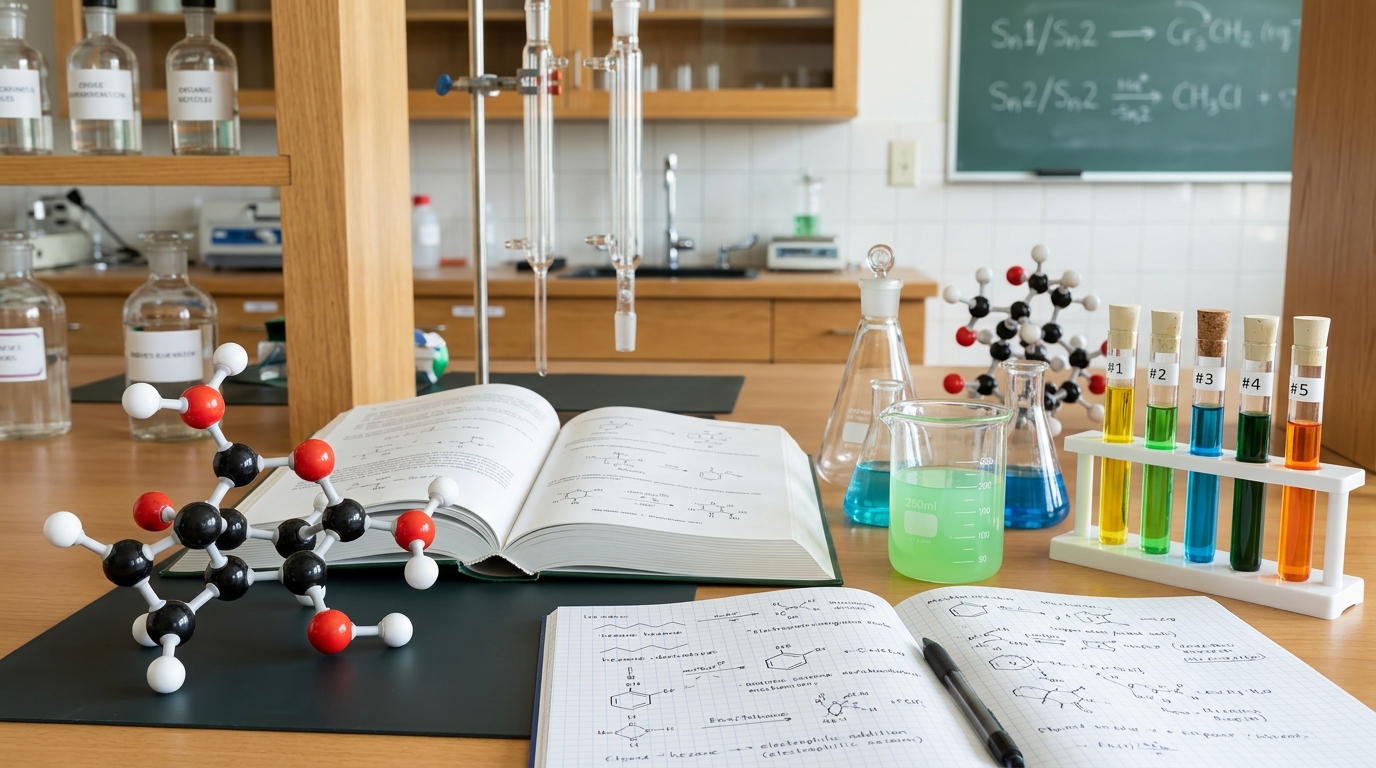

La chimie organique fait peur à beaucoup d'étudiants, mais elle est prévisible au concours. Cet article couvre les réactions essentielles, les mécanismes à maîtriser et les pièges fréquents avec des QCM d'entraînement.
Table of Contents
Les fonctions organiques essentielles pour le concours
Au concours de médecine au Maroc, les questions de chimie organique portent principalement sur 6 familles de fonctions organiques. Si vous maîtrisez ces 6 familles, vous couvrez environ 80% des questions possibles.
| Fonction | Formule générale | Fréquence au concours | Difficulté |
|---|---|---|---|
| Alcools | R-OH | Très fréquent | Moyenne |
| Acides carboxyliques | R-COOH | Très fréquent | Moyenne |
| Esters | R-COO-R' | Fréquent | Haute |
| Amines | R-NH2 | Fréquent | Moyenne |
| Aldéhydes | R-CHO | Occasionnel | Moyenne |
| Cétones | R-CO-R' | Occasionnel | Moyenne |
Les réactions incontournables du concours
Voici les 5 réactions les plus testées au concours de médecine. Pour chacune, retenez les réactifs, les produits et les conditions opératoires.
1. L'estérification (acide + alcool → ester + eau)
C'est la réaction la plus testée en chimie organique au concours. Retenez qu'elle est lente, limitée (réversible), et nécessite un catalyseur acide (H2SO4) ou un chauffage. L'hydrolyse de l'ester est la réaction inverse.
2. La saponification (ester + soude → savon + alcool)
Contrairement à l'estérification, la saponification est totale et lente. Elle produit un carboxylate de sodium (le savon) et un alcool. C'est une réaction irréversible.
3. L'oxydation des alcools
Les alcools primaires s'oxydent en aldéhydes puis en acides carboxyliques. Les alcools secondaires s'oxydent en cétones. Les alcools tertiaires ne s'oxydent pas (dans les conditions douces). Ce classement est un grand classique du concours.
❓ Question de pratique
L'oxydation ménagée du butan-2-ol donne :
- Le butanal
- La butanone
- L'acide butanoïque
- Aucun produit (alcool tertiaire)
Comprendre les mécanismes réactionnels
Au concours, les questions ne portent pas sur la description détaillée des mécanismes, mais sur leur compréhension globale. Vous devez savoir distinguer une substitution d'une élimination, et une addition d'une condensation.
Les réactions de substitution nucléophile (SN1 et SN2) apparaissent régulièrement dans les QCM de chimie organique. Le piège classique est la stéréochimie : la SN2 inverse la configuration (inversion de Walden), tandis que la SN1 produit un mélange racémique.
"J'avais 8/20 en chimie organique avant de découvrir FMPrepa. Les explications détaillées de chaque QCM m'ont aidé à comprendre les mécanismes au lieu de les mémoriser bêtement. J'ai fini avec 16/20 en chimie au concours."
La nomenclature IUPAC : les règles à connaître
Nommer correctement une molécule organique est souvent le premier pas pour résoudre un exercice. Les erreurs de nomenclature entraînent des erreurs en cascade. Voici les règles fondamentales :
- Chaîne principale : la plus longue chaîne carbonée contenant la fonction prioritaire
- Numérotation : attribuer le plus petit indice à la fonction principale
- Substituants : nommés en préfixe par ordre alphabétique
- Suffixes : -ol (alcool), -al (aldéhyde), -one (cétone), -oïque (acide)
❓ Question de pratique
Le nom IUPAC de CH3-CH(OH)-CH2-CH3 est :
- Butan-3-ol
- Butan-2-ol
- 2-méthylpropan-1-ol
- Butanol
Les pièges classiques du concours en chimie organique
Voici les 5 pièges les plus fréquents :
- Confondre estérification et saponification : l'une est limitée, l'autre est totale
- Oublier que les alcools tertiaires ne s'oxydent pas en conditions douces
- Erreur de nomenclature : numérter dans le mauvais sens
- Confondre aldéhyde et cétone : la position du groupe C=O diffère
- Oublier la stéréochimie : une réaction SN2 inverse toujours la configuration
"La chimie organique me semblait impossible. Grâce aux QCM de FMPrepa, j'ai identifié les 5 pièges récurrents et j'ai pu les anticiper le jour J. Résultat : 14/20 en chimie alors que je visais 10."
Plan de révision pour la chimie organique
"En chimie organique, comprendre un mécanisme vaut mieux que mémoriser cent réactions."
- Pr. Rachid M., enseignant en chimie, FMPC✅ Méthode efficace
- Comprendre les mécanismes avant de mémoriser
- S'entraîner sur les QCM des annales
- Faire des fiches de synthèse par fonction
- Utiliser le tuteur IA pour les doutes
❌ À éviter
- Apprendre les réactions par coeur sans comprendre
- Négliger la nomenclature IUPAC
- Sauter les exercices de stéréochimie
- Réviser la chimie organique à la dernière minute
- Maîtrisez les 6 fonctions organiques principales et leurs réactions
- Comprenez les mécanismes (SN1, SN2, élimination, addition)
- La nomenclature IUPAC est la base de tout
- Entraînez-vous sur les QCM corrigés de FMPrepa
- Analysez les pièges récurrents des annales
❓ Question de pratique - Défi
La saponification d'un ester par la soude (NaOH) produit :
- Un acide carboxylique et un alcool
- Un carboxylate de sodium et un alcool
- Un ester et de l'eau
- Un savon et un acide
Entraînez-vous en chimie organique
Plus de 800 QCM de chimie avec des corrections détaillées vous attendent sur FMPrepa.
Accéder aux QCM de chimie